
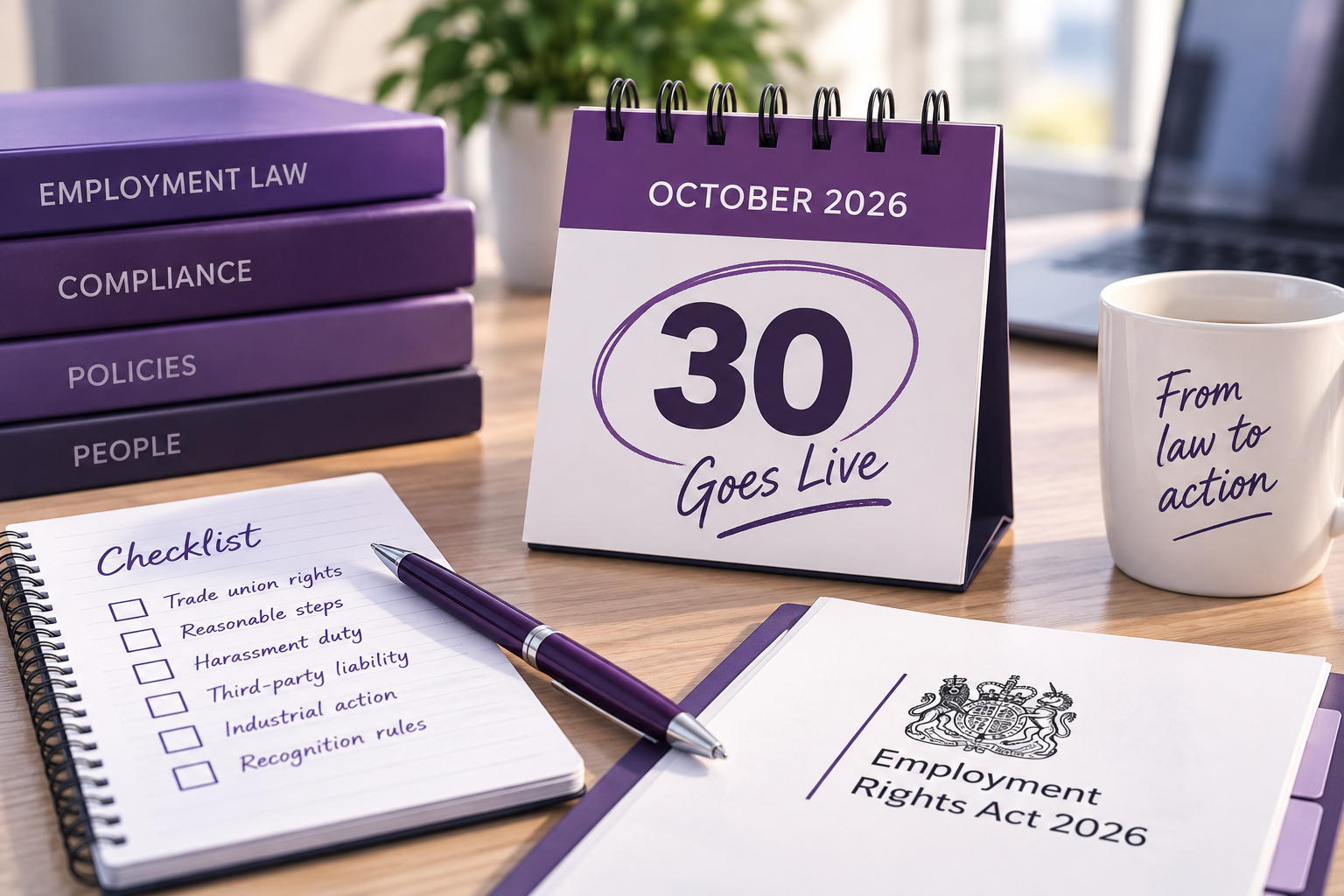
Everything That Goes Live Today: The 30 October 2026 Wrap-Up
If you’ve been following this series through October, today is the date a large chunk of it actually becomes law. Rather than one more deep dive, this is a single, practical checklist bringing together everything commencing on 30 October 2026 — with links back to our full coverage of each, so you can jump straight to whichever affects your business most.
What’s commencing today
Trade union right of access to workplaces. Unions can now request physical or digital access to your workplace to recruit, organise, and represent workers — even where they currently have no members — if you employ 21 or more people. You have 15 working days to respond to a request. Full detail: our trade union rights and recognition coverage, and our piece on how to respond to an access request.
The “all reasonable steps” harassment duty. The existing duty to take reasonable steps to prevent sexual harassment is now a duty to take *all* reasonable steps — a genuinely higher bar, with compensation uplifts of up to 25% possible where the duty is found to have been breached. Full detail: The Duty to Prevent Sexual Harassment Just Got Stronger.
A new duty to prevent third-party harassment. For the first time since 2013, employers can be liable for harassment of an employee by a customer, client, patient, or visitor, where they failed to take all reasonable steps to prevent it — and a single incident is now enough to found a claim. Covered in the same article above.
Increased detriment protection for industrial action. Beyond the dismissal protection that’s already been in force since February, workers taking part in lawful industrial action now also gain stronger protection against being treated unfavourably short of dismissal. Full detail: Dismissing Someone for Taking Industrial Action.
Unfair practices rules during union recognition and derecognition. An updated Code of Practice takes effect, giving practical guidance on avoiding unfair practices — bribery, coercion, threats, or improperly influencing a recognition ballot — with unions now able to seek earlier access to the workforce during a live recognition process.
What’s still pending, even though it was expected around now
Not everything on our radar for this period has actually landed — worth being clear on what’s still open:
- The tipping policy consultation requirement — as we covered in our tipping Code article, this was originally expected around this time but has been pushed back following a further consultation. Continue following the existing 2024 Code for now.
- The government’s response on non-compete clause reform — the consultation closed back in February and, as of writing, no confirmed direction has been published.
A quick self-check for today
If you haven’t already, run through this before the week’s out:
- Do you know who in your business would handle a trade union access request, and could you meet the 15-working-day response window if one landed tomorrow?
- Has your harassment policy been reviewed against the higher “all reasonable steps” standard, including specifically covering third parties like customers or service-users?
- Are your managers briefed on the stronger industrial action protections, if your business has any live workplace disputes?
- Is your record-keeping already reflecting the longer tribunal time limits we covered earlier this month?
What’s next
This isn’t the end of the reform programme — 2027 brings further changes we’ve flagged throughout this series, including the reduced unfair dismissal qualifying period, stronger fire and rehire restrictions, the flexible working reasonableness test, and the new bereavement leave right. We’ll keep covering each as it approaches.
How Cheviot HR can help
If any of the checklist above feels like a gap rather than a tick, that’s exactly what we’re here for. We can run a full compliance review against everything commencing today, prioritise what needs attention first, and get your documentation, policies, and processes properly up to date.
Get in touch at heidi@cheviothr.co.uk or visit https://cheviothr.co.uk to talk through what this means for your business.
Ready for 1 January 2027?
Our free two-page checklist shows exactly what employers need to sort before the new rules start, from six-month unfair dismissal rights to the new trade union statement.
Get the free checklist